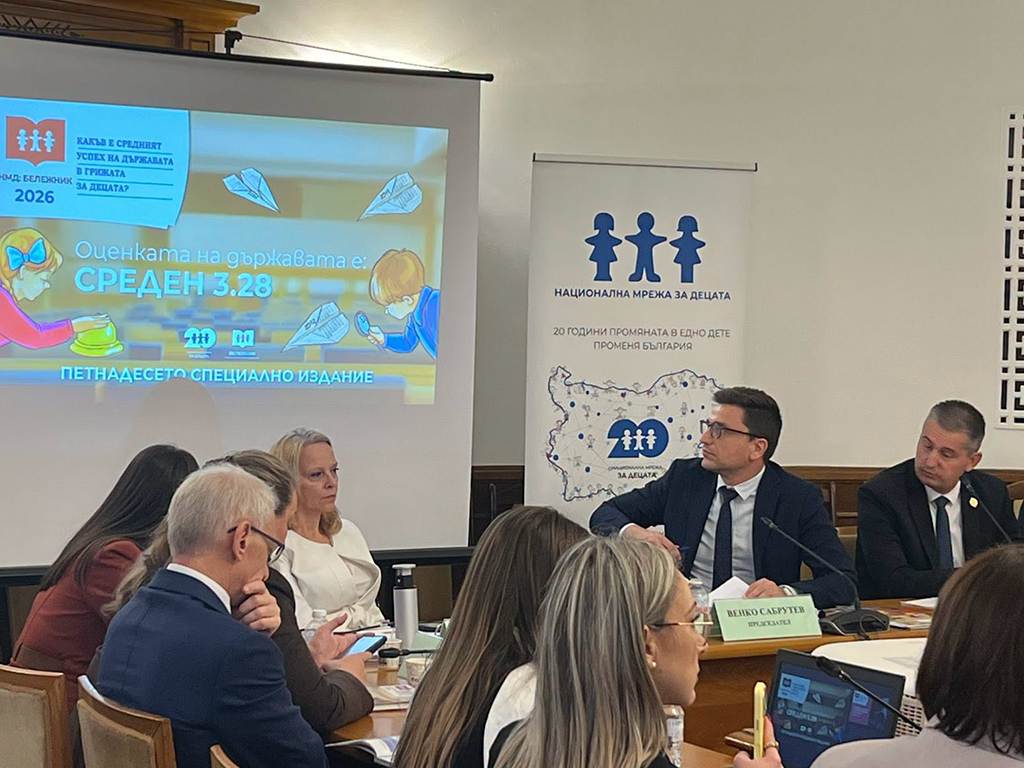
“Report Card 2026” Presented to Parliament: The State Receives a 3.41 for Its Support for Families and the Provision of Alternative Care for Children

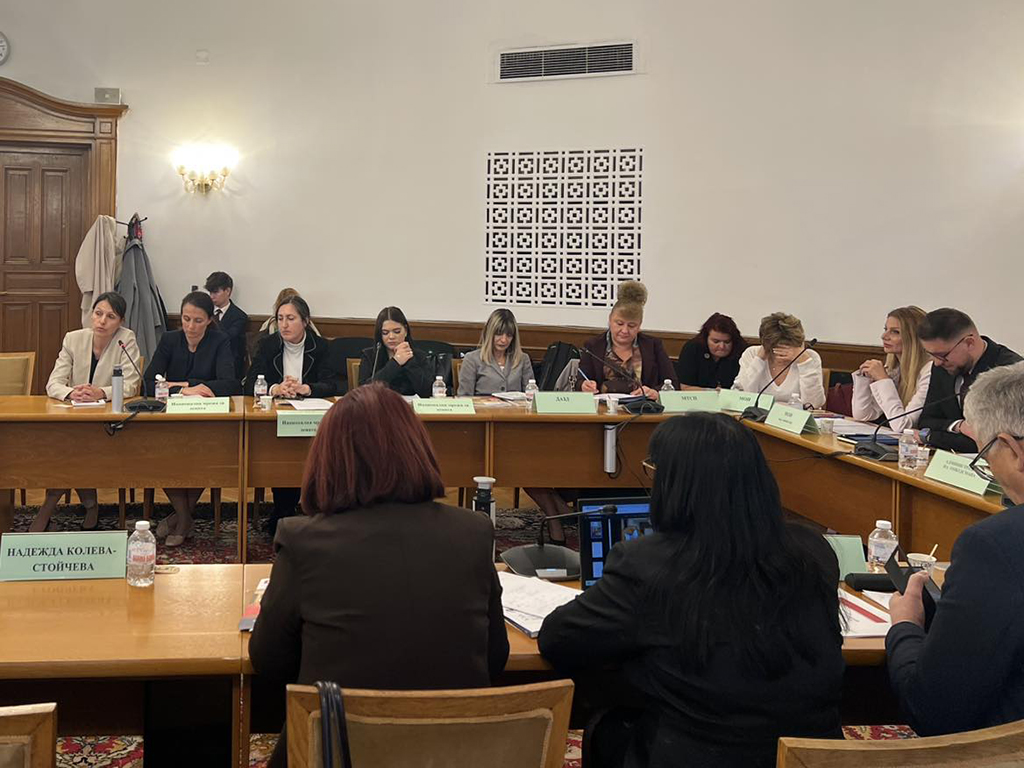
Aleksandrina Dimitrova, Executive Director of Cedar Foundation and Chair of the National Network for Children's Board, highlighted the importance of preventing family separation and called for a clear, long-term vision for foster care.
“If I asked you whether children in Bulgaria should live in a safe family environment, you would all say yes. Hardly anyone would need to think twice. And yet, it turns out that we, as a state and society, have failed to do enough to ensure that every child in Bulgaria can grow up in a safe family environment.”
 
“The Report Card: What Grade Does the State Receive for Its Care for Children?” is an annual monitoring report the National Network for Children has published for 15 years. It assesses how state policies concerning children and families have upheld and implemented children’s rights over the years.
 
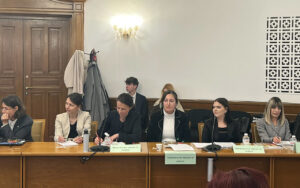
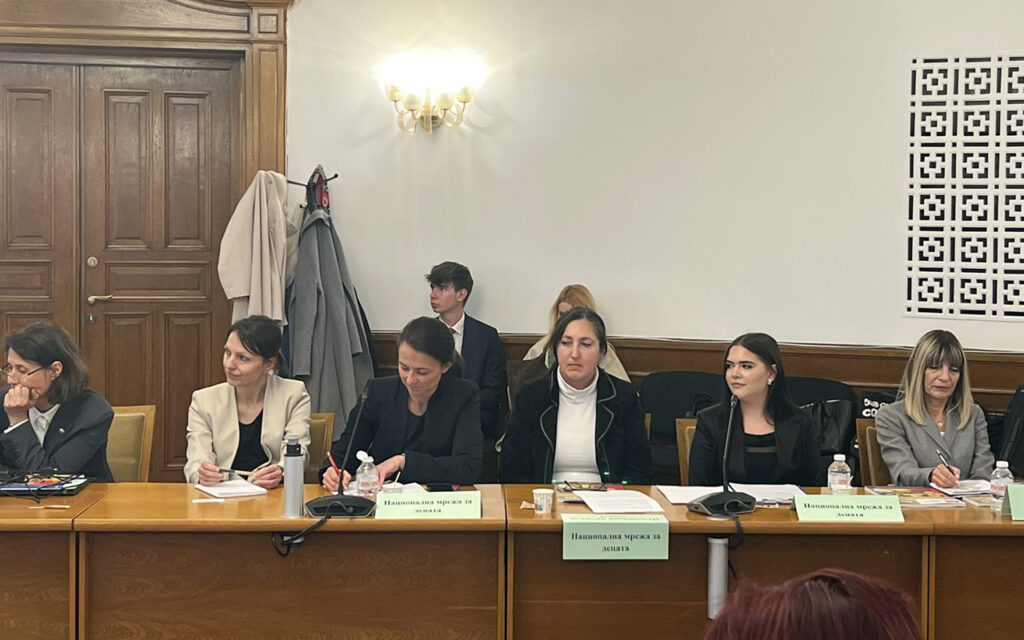
In her address to the Parliamentary Committee on Labour, Social and Demographic Policy, Ms Dimitrova drew MPs’ attention to several key findings from the report, sharing her expertise in residential care services for children and young people, with and without disabilities. She spoke about preventing children from being separated from their families, the alternative care options available to them, and staffing capacity within the child protection system.
 
Preventing children from being separated from their families means supporting families so that children can grow up with their birth families. This principle is enshrined in all of the state’s strategic documents. “Unfortunately, however, we see that support measures often come too late, when the crisis has already escalated to such an extent that these measures prove ineffective.”
 
Dimitrova highlighted the progress made over the past 15 years in closing almost all state-run institutions for children (137 institutions in 2010, accommodating approximately 7,600 children). She also called on the Ministry of Health to close the two remaining Homes for Medical and Social Care for Children in Pleven and Varna by the end of 2026, where around 100 children currently live.
 
She pointed to the harm caused to children by growing up in such institutions, as demonstrated by scientific research and practical experience. She also stressed that Bulgarian legislation in this area is aligned with international standards and practices. It provides for removing children from their families only as a last resort, after which priority must be given to finding an alternative family environment – first with relatives or close family members and, when this is not possible, with a foster family. Residential care services are considered only as a last resort. Besides being the least suitable option for children, they are also the most expensive, as they involve round-the-clock care provided by a team of specialists.
 
“Despite this, twice as many children currently live in residential care services as in foster care. In other words, we say that a family environment is better for children, yet we continue to place more of them in residential care services,” Dimitrova emphasised.
Today’s residential care services offer very different conditions from the children’s institutions of the past. They are located in accessible areas, have more staff, children live in much smaller groups and are no longer so isolated. However, the contradiction remains between the priority given to family-based care in the law and the reality on the ground.
 

Cedar Foundation’s experience in this area shows that there is a continuous need to accommodate children in its residential care services, while the age of the children referred to the foundation has shifted from teenagers to children between 7 and 10 years old. There are also cases in which children are initially placed with foster families but later come to Cedar because the families turn out to be unprepared for the challenges involved. For children with disabilities, finding a foster family is practically impossible.

As the reason behind this situation, Dimitrova pointed to the lack of a sufficient number of well-prepared foster families. She called for a renewed debate on foster care in Bulgaria, sustainable funding and a clear vision for its development. Cedar Foundation believes that residential care services should be a last resort and should become more specialised, accommodating only a small number of children for whom this is the best available alternative.

Regarding staffing capacity within the child protection system, Dimitrova noted that nearly half of the employees in the Child Protection Departments do not have the required educational background in social work. Their heavy workloads and administrative responsibilities also limit the time they can devote to direct work with children and families. Further professional training, supervision and working conditions that allow social workers to fulfil their core professional role are essential – assessing needs and providing appropriate support.

“I would like to address you not only as Members of Parliament, but also as parents, as I assume many of you are. You know very well that, first and foremost, a child needs care. And care is provided by people. Let us think about children who face difficulties and, unfortunately, cannot be raised by their birth families by considering how we invest in the people who support families and in those who care for the children.
Because people are the ones who make care possible.”
 
* The Report Card points out that the number of occupied places in Community-Based Residential Care Centres (CBRCCs) for children and young people is lower than the total available capacity (3,125 out of 3,721 places are occupied). However, the National Map of Social Services envisages increasing their capacity to 4,289 places. According to the report’s authors, this is unjustifiable and contradicts the evidence of the harm caused by residential care, policies aimed at preventing children’s placement in such services, and the accumulated evidence that the quality of these services remains unsatisfactory.
 

Read the full Report Card here.
recent

Read Also

Going to work – a story about a dream come true

He was born in a small country in Eastern Bulgaria. He doesn’t know his dad, whom he…

Workout with a cause

Multisport supports the Cedar Foundation through the charity initiative “Sneakers Day”…

The therapeutic power of food

For the second year in a row we aim to raise funds for young people’s favorite culinary…

Limits or new opportunities for disadvantaged children

We held a hybrid charity event to support children and youth at risk…

For infinite possibilities

We are pleased to present our work and receive support from friends and donors of the organization…

(Un)expected Journey

After more than a year of not being able to travel, we visited Veliko Tarnovo…